Life’s A Pleach. | Why pleached trees might be one of the smartest additions to your garden.
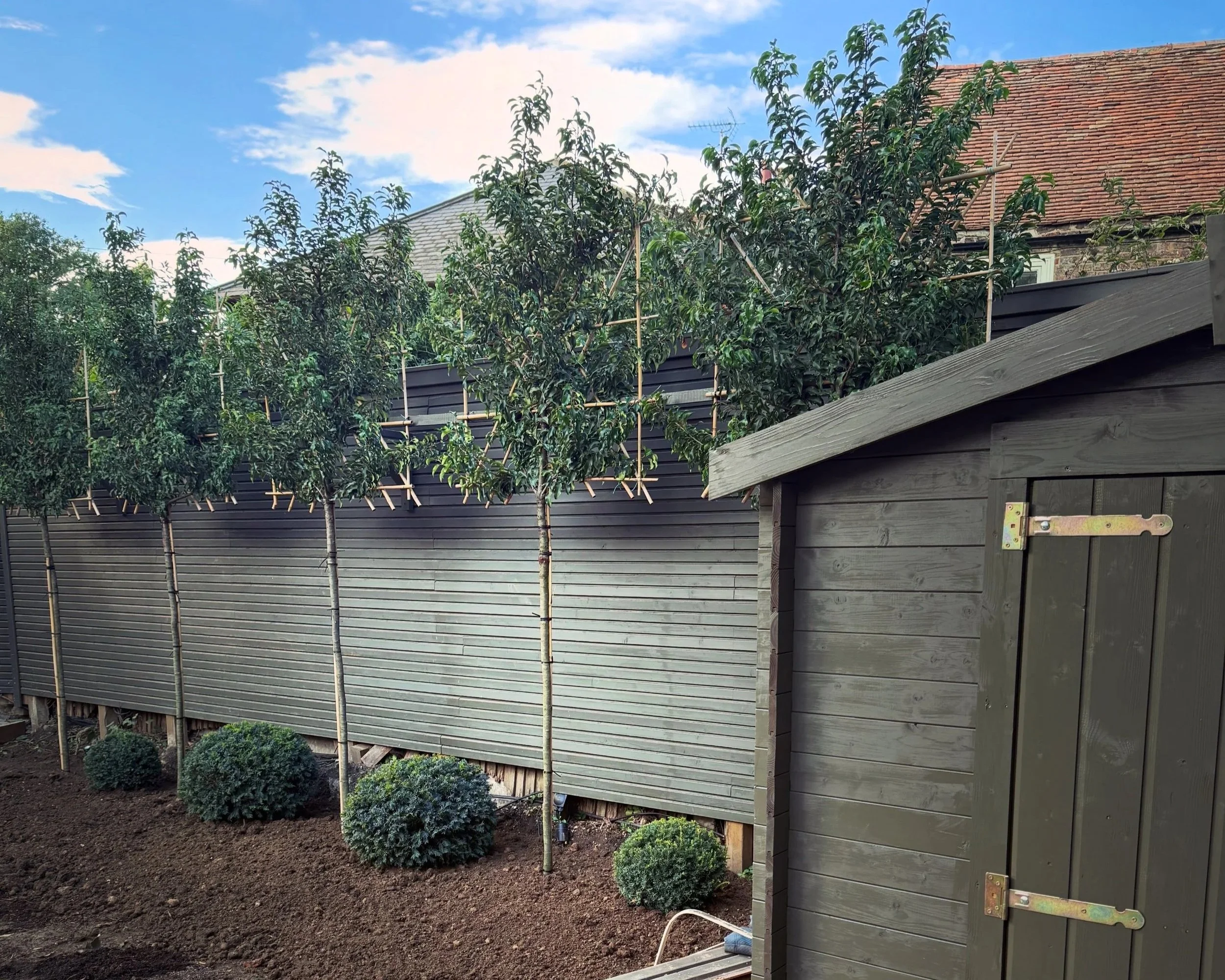
A row of Pleached Trees I recently planted in a client’s garden in Deal, Kent.
Pleached trees might just be one of the smartest additions to your garden.
I’ve been planting pleached trees for a client project in Deal this week, and it’s reminded me how much I love using them in a garden design. For anyone unfamiliar with the term, ‘pleached’ trees are trees that have been specially trained to grow with a clear, straight trunk and a flat, rectangular canopy of foliage above. Think of them as a hedge on stilts.
They’ve been used in formal European gardens for centuries, particularly in France and Italy, where you’ll often see them lining avenues, framing terraces or creating wonderfully architectural green walls. And they’re equally at home in a contemporary British garden too.
A little privacy, please!
A common challenge when designing residential gardens for my clients, is privacy from overlooking neighbours. It’s a particular issue in towns & cities, where houses are close together. You might have a good boundary fence, but that doesn’t stop someone looking down at your garden from their bedroom window. This is where pleached trees can be a helpful tool. Because the canopy sits above a clear trunk, you can create a lovely, dense screen of foliage at exactly the height where you need privacy, without having to plant an enormous hedge or block out the whole garden.
The space underneath the canopy remains open, allowing you to plant borders, position furniture or simply enjoy a view across the garden.
And unlike planting conventional trees and waiting years for them to grow, you can buy pleached specimens that have already been trained to a particular height and width, giving you a fairly instant result.
It’s worth remembering that no tree can guarantee complete privacy from every angle, but a carefully positioned row of pleached trees can make an enormous difference.
A touch of class
I also love pleached trees for their architectural qualities.
There’s something rather elegant about a beautifully proportioned row of trees, with their canopies neatly aligned above the garden. They introduce a sense of order and structure and can make even a relatively modest garden feel rather grand.
I think they work particularly well when you want to create a contrast between formal structure and softer, more naturalistic planting.
Imagine a row of clipped evergreen pleached trees with loose ornamental grasses and flowering perennials underneath. That combination of strong geometry and informal planting is something I’m particularly fond of (and exactly what I am planting at my project in Deal)
They’re also brilliant for framing a view, creating a backdrop to an outdoor dining area or introducing a sense of enclosure without making the garden feel boxed in.
And while we often associate pleached trees with grand country estates and classical gardens, they can look equally stylish alongside contemporary architecture.
Choosing the right trees
There are quite a few species that can be grown as pleached trees, and choosing the right one is important. As with any planting scheme, I always start by looking at the conditions of the garden. Soil type, drainage, exposure to wind and the amount of sunlight all influence what will grow successfully.
You also need to decide whether you want an evergreen screen that provides privacy throughout the year, or whether you’re happy with a deciduous tree that changes with the seasons.
Here are some of my favourites:
Portuguese Laurel | Prunus lusitanica ‘Brenelia’
This is the variety I planted in Deal (in the photo above), and it’s a particularly handsome choice.
Portuguese laurel has relatively small, glossy dark green leaves and attractive reddish stems. It creates a dense, refined canopy that responds well to clipping, making it ideal for pleaching.
‘Brenelia’ is a cultivar with a naturally upright habit, which makes it particularly well suited to training into a neat, formal screen.
It’s evergreen, so provides privacy throughout the year, and is generally happy in sun or partial shade. It will grow in a range of soil types, including clay, provided the ground drains reasonably well.
In Deal, we had to navigate heavy clay soil and had a client requirement for year-round privacy. Portuguese laurel was a very good fit. I’d describe this tree as one of my favourite options for a smart, classic evergreen screen.
Hornbeam | Carpinus betulus
Hornbeam is probably one of the most traditional choices for pleaching, and for good reason.
It’s a tough, reliable tree that tolerates heavy clay soils and colder conditions particularly well. It grows happily in sun or partial shade and responds beautifully to regular pruning.
Its fresh green leaves turn golden brown in autumn. Although deciduous, clipped hornbeam can retain some of its old leaves through winter, providing a degree of screening even after the growing season has finished.
For a traditional English garden, it’s a wonderful choice.
Common Beech | Fagus sylvatica
Beech is another classic, and I particularly like its soft, fresh green foliage in spring and the rich coppery colour it develops in autumn.
Like hornbeam, beech can hold onto its dry leaves through winter when regularly clipped, which gives the screen a lovely seasonal character.
Beech prefers well-drained soil and is less tolerant of heavy, wet clay or prolonged drought. It works best in sun or light shade, in a reasonably sheltered position.
If the soil is particularly heavy or prone to waterlogging, I’d generally choose hornbeam instead.
Photinia | Photinia × fraseri ‘Red Robin’
For something more colourful, Photinia is worth considering.
It’s an evergreen with glossy leaves and brilliant red new growth, particularly in spring. Regular clipping encourages fresh shoots, creating an interesting contrast between the red and green foliage.
It prefers sun or partial shade and reasonably fertile, well-drained soil. It can cope with clay, provided drainage is good. However, it does appreciate some shelter. Cold, exposed sites can lead to damaged foliage and leaf spot, so I wouldn’t automatically choose it for a particularly windswept coastal garden.
It’s a good option for someone who wants a more colourful and slightly less traditional look.
Are there any drawbacks?
As much as I love pleached trees, there are a few things worth considering before rushing out to buy a row of them.
Firstly, they’re not cheap. Expect to pay around £400+ per tree, depending on type and size. You’re buying a tree that has already spent several years being grown and trained in a nursery, and that time and expertise is reflected in the price. Larger, more mature specimens can be a significant investment, particularly if you need several.
They also need maintenance. To keep that lovely rectangular shape, the canopies need regular clipping, usually once or twice a year depending on the species and how vigorously it’s growing. And because the foliage is above head height, that can involve ladders or a professional gardener.
Another consideration is light. Although the clear trunks allow light through at ground level, a dense row of evergreen canopies will inevitably cast shade. That’s something I always consider carefully, particularly in smaller gardens where neighbouring buildings may already restrict sunlight.
And finally, there’s the question of space. Pleached trees might be relatively narrow, but they’re still living trees with growing root systems. They need adequate soil volume, moisture and room to establish. They shouldn’t be squeezed into a tiny planting strip simply because their canopies look slim.
How are pleached trees planted?
Most pleached trees are purchased ready-trained from specialist nurseries, with their branches supported on a temporary bamboo or timber framework.
The first job is to work out exactly where they’re going. Spacing is important, particularly if you’re planting a row and want the canopies to eventually form a continuous screen.
I like to set everything out before digging, checking the alignment, the finished canopy height and how the trees will look from the house as well as from within the garden.
The planting process itself is much like planting any other tree. The planting hole should be wide enough to accommodate the root ball comfortably, with the tree positioned at the correct depth and the root flare at ground level.
On heavier clay soils, it’s especially important to check drainage and avoid planting into compacted or waterlogged ground.
Because pleached trees have quite large canopies sitting above relatively slender trunks, they can catch a surprising amount of wind. A proper staking system is essential while the roots establish. This might involve substantial timber stakes and flexible tree ties, or a more discreet underground anchoring system.
The trees then need thorough watering and a generous mulch around the base, keeping the mulch away from the trunk itself.
And don’t underestimate the watering. Even established-looking pleached trees need careful attention during their first couple of growing seasons, particularly through hot, dry summers.
Over time, the branches can be trained across the gaps between neighbouring canopies, creating that beautiful continuous green screen.
A final thought
I think pleached trees are one of those garden design features that can completely transform the character of a space.
They’re practical, certainly, particularly when privacy is an issue. But it’s their elegance that really appeals to me.
There’s something timeless about a row of beautifully trained trees. They can give a garden a sense of maturity and permanence from the moment they’re planted, and they work with so many different architectural styles.
Our newly planted Portuguese laurels in Deal are already making an impact, and I’m looking forward to seeing them develop as the garden matures.