What Are You Paying For When You Hire a Garden Designer?
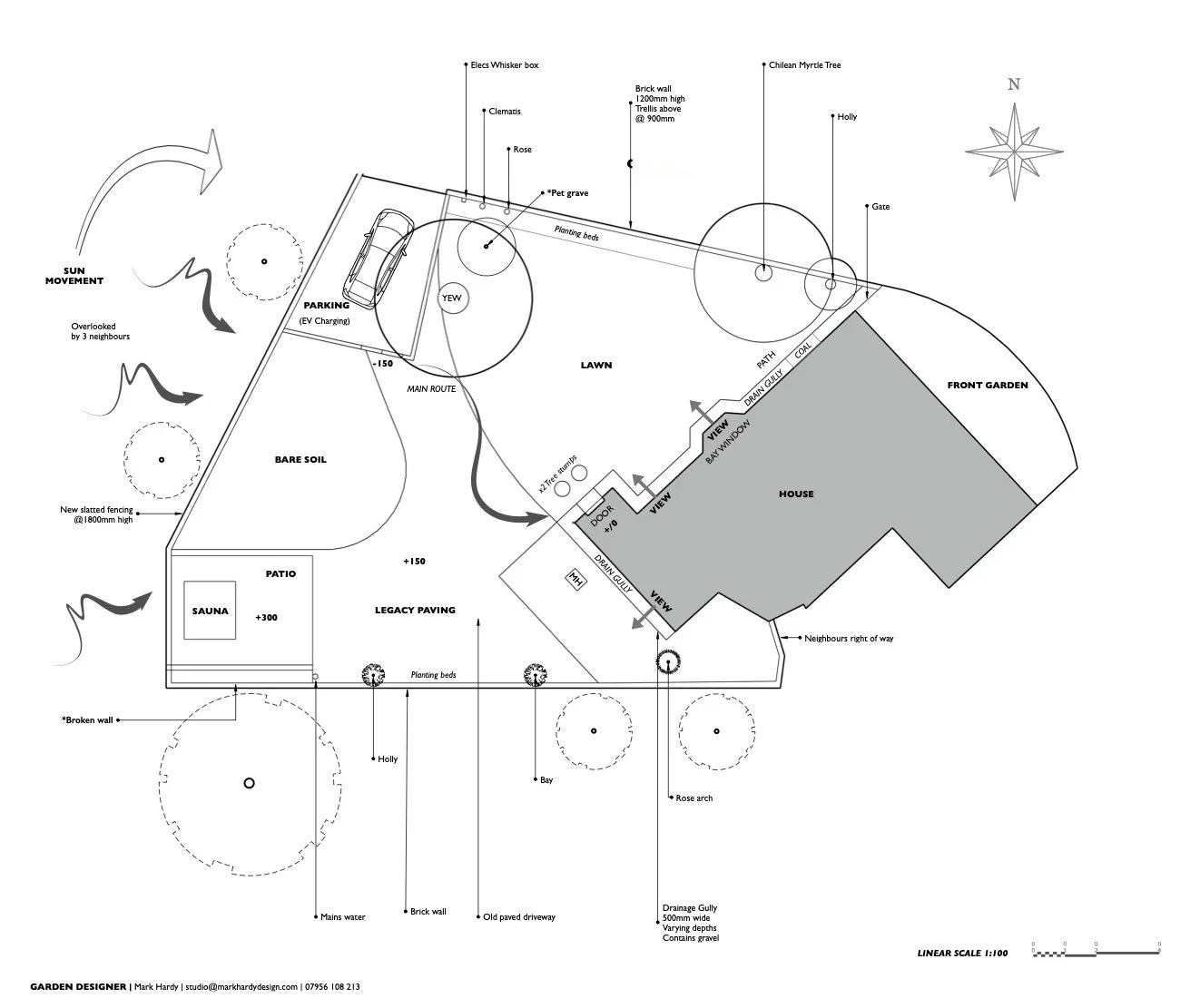
Its not just about pretty pictures…
The drawings are only part of it. Most of the value sits in the decisions behind them.
What are you actually paying for when you hire a Garden Designer?
It’s a fair question.
After all, at the end of the design stage you might be looking at a set of plans, some 3D visuals, material choices and a planting scheme. But the drawings are really just the visible bit. What you’re actually paying for is the thinking behind them.
Turning a lot of choices into one clear idea
Gardens involve an extraordinary number of decisions.
How big should the terrace be? Where should the path go? Do we need steps? What material should they be made from? Where does the planting begin? How much lawn is enough? Where should the trees go? What happens to the rainwater? How is the garden lit? Where does the garden furniture actually fit? And more…
None of those decisions exists in isolation.
Move the terrace and you might change the levels. Change the levels and suddenly the steps need rethinking. Move the tree and the view changes. Change the paving and the whole character of the garden can shift.
A Garden Designer’s job is to hold all of those things together.
Not just to produce lots of nice ideas, but to work out which ideas belong in this garden and which ones don’t.
Editing is a big part of design
There is no shortage of inspiration anymore. Pinterest, Instagram, magazines and garden shows are full of brilliant ideas. The difficulty is rarely finding things you like. It’s knowing what to leave out. A garden can very quickly become a collection of individually lovely things that don’t particularly belong together. Before you know it, the garden has become a very expensive mood board.
Good design needs a bit of restraint.
Part of what you are paying for is somebody willing to say: yes, that works.
And occasionally: no, I really don’t think you need that.
Getting the proportions right
This is one of those things that sounds simple until it isn’t.
A terrace can be beautifully paved and still feel wrong because it’s slightly too small. A path can be made from the perfect material but feel mean because it isn’t wide enough. A planting bed can contain all the right plants and still look underwhelming because its proportions are wrong for the space. Good proportions are one of the things you tend to notice only when they haven’t been considered properly. When they work, you probably won’t think about them at all. You’ll simply be able to pull a chair back from the dining table without ending up in the flower bed.
Which is usually a good thing.
Designing things before they become expensive
Gardens cost a lot of money to build.
That makes the design stage a relatively inexpensive place to make mistakes. Moving a wall 300mm on a drawing is easy. Moving it after somebody has built it is rather less so.
The same applies to levels, drainage, lighting, paving layouts, steps, structures and planting. A large part of professional garden design is anticipating decisions before they arrive on site. The more that can be resolved on paper, the fewer things have to be improvised during construction.
And improvisation becomes considerably less charming when there’s a landscaper, an excavator and three tonnes of stone waiting for an answer.
Giving the landscaper something proper to build
A concept drawing can communicate an idea, but a landscaper needs more than that.
Once a design is agreed, the technical information explains how the garden should actually be put together. Dimensions. Levels. Materials. Construction details. Drainage. Lighting positions. Planting. Specifications. The exact package depends on the project, but the principle is always the same. The design shouldn't exist only inside the designer's head. Everybody involved in building the garden should be able to understand what has been designed and what they are being asked to price and construct. That also makes comparing quotations considerably easier.
If three landscapers are pricing three slightly different interpretations of the same vague idea, the cheapest quotation may not actually be the cheapest garden.
Knowing where to spend the money
Not every part of a garden needs to be expensive.
And spending more doesn’t automatically make something better. Sometimes the right thing is to invest in beautiful paving because it sits directly outside the house and you’ll see it every day. Elsewhere, a simpler material might work perfectly well.
A mature tree might be worth spending money on because it transforms the whole space immediately. In another part of the garden, smaller plants may establish perfectly happily over time.
Design is partly about making choices. Where should the budget work hardest? What is worth protecting? Where can we simplify without compromising the overall idea? A good garden is rarely about specifying the most expensive version of everything.
Thank goodness.
And yes, you're also paying for experience
Garden designers have seen things work.
We’ve also seen things not work.
Materials that looked wonderful in a showroom but behaved very differently outside. Plants that were completely wrong for a particular spot. Details that seemed insignificant on paper but became very significant during construction. Experience doesn’t mean there will never be surprises.
It means you’re better equipped to deal with them when they appear.
The finished garden should feel simple
This is probably the oddest thing about good design.
A lot of work can go into making something feel effortless. By the time the garden is finished, you shouldn’t be walking around thinking about all the decisions that went into it. The path should simply feel like it goes in the right direction. The terrace should feel generous enough. The planting should belong there. The materials should make sense with the house. Everything should feel connected. That’s really what you’re paying for. Not just a drawing of a garden.
You’re paying for someone to work through hundreds of decisions before they become hundreds of problems.
And, if we’ve done the job properly, most of that work becomes almost invisible once the garden is finished.
Mark Hardy Design creates residential gardens across Kent, London and the South East, from concept and technical design through to planting and Design Management during construction.