Back to school at 50.
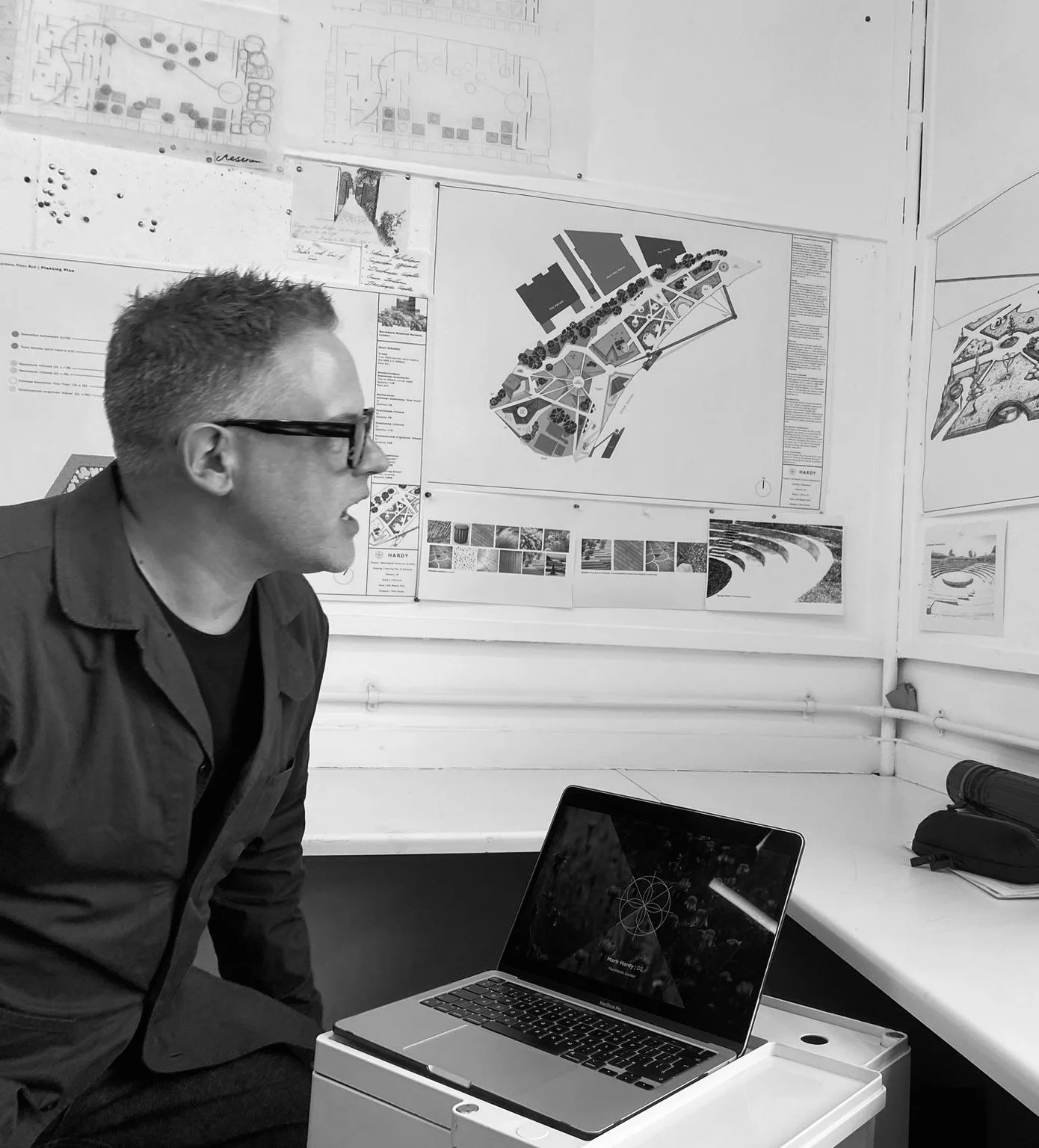
Presenting work as a student at The Inchbald School of Design in Chelsea, London.
Why leaving a 30-year career to become a Garden Designer felt less like starting again and more like moving forward.
I trained to be a Garden Designer at 50.
Even writing that now, it feels quite significant. Not because 50 is particularly old, but because by that age I’d already had a huge career.
I’d spent over 30 years working in Marketing and PR for businesses including Disney, PlayStation and Sony Music. It was a world I knew well and a career I’d loved for a long time. I worked alongside some brilliant people, travelled the world, had extraordinary experiences and led projects I’m still incredibly proud of.
I wasn’t running away from it when I decided to make a change. I was just ready for something new. And I knew I wanted that something to be centred on being creative again.
Gardens and gardening had been a growing interest of mine for years, but increasingly it was the design of them that fascinated me most. Not simply which plants looked good together, but why a space worked. The relationship between a house and its garden. How a path takes you somewhere. Why the position of a tree matters. Materials, proportion, views, light, levels. The decisions that make an outside space feel completely connected to a house. I wanted to understand and learn all of this properly and give myself the best possible foundation for what I hoped would become my second career.
I enrolled at the Inchbald School of Design in London to study Garden & Landscape Design. And I threw myself into it completely.
I loved being a student again. Being challenged and learning a completely new discipline. New ways of thinking, new skills to develop and a huge amount of technical knowledge sitting behind something I’d previously experienced mainly as an amateur gardener.
I found the whole process wonderfully absorbing. There were long days and plenty of hard work, but I knew why I was there. I had chosen to do this and, perhaps because I was older, I didn’t want to waste a minute of it.
I graduated with a Distinction and was awarded the Dean & Founders Prize. I was really proud of myself and this did wonders for my confidence. But probably more importantly, I felt I’d found something I really wanted to get good at. Not just for the course, but for the next chapter of my working life.
You don’t leave everything you’ve ever known behind when you start something new like I did. I may have been learning a new profession, but I wasn’t suddenly a different person. Thirty years working in Marketing and PR had taught me an enormous amount about people: How to listen and how to ask the right questions. How to take lots of information and find the nub of the most important bit. How to develop an idea and communicate it clearly. How to manage budgets, expectations, personalities and the occasional curveball.
I use those skills every day now.
Before I even start drawing a garden, I spend a lot of time talking to the people who are going to live in it. Understanding how they live, what matters to them and what they want their garden to give them.
In some ways, that’s not so different from what I spent much of my previous career doing. The subject has changed considerably, but the people bit hasn’t.
Of course, going back to school was just the start, as I also wanted to build a successful garden design practice. That has probably been one of the most satisfying parts of my midlife career change. There is something very immediate about designing a garden for a private client. You meet someone at their home, stand in the space together and start imagining what it could become. Then, over the following weeks, ideas develop into drawings and planting plans, materials and technical details. Then the landscapers get started and something that only existed as an idea on paper becomes a reality.
I don’t think I’ll ever tire of that.
There is a particular moment during a build when the lines you’ve drawn begin to appear on the ground. A wall is in exactly the place you imagined it. A tree arrives. The planting goes in.
Suddenly you can walk through something that previously only existed in your head. That’s pretty special too.
Would I have done things differently?
People ask whether I wish I’d become a Garden Designer earlier. I don’t.
My first career wasn’t time spent waiting for my second one to begin. It was nearly 30 years of my life and I’m enormously grateful for it.
And I think I’m a better Garden Designer because of it. I’ve got more experience of people. More confidence in my own judgement. A better understanding of what I’m good at and, just as importantly, when someone else knows more than I do. There are advantages to arriving at something later. You know yourself better.
It’s never too late to do something new, but I hesitate slightly with this comment because changing career in midlife can quickly turn into one of those motivational posters: ‘IT’S NEVER TOO LATE!’. Real life is a little more complicated and changing career can have practical consequences.
You have to think about money. You may need to retrain. You might have to take a few steps backwards professionally before you can move forwards again.
I thought about all of those things. But I also thought about the alternative.
I could quite easily have continued doing something I already knew how to do with my eyes closed.
But here I am now. Four years later, I have my own Garden Design practice. I’m working on projects in London, across Kent and the South East, and I’m building a career that I hope will keep challenging and interesting me for many years to come.
I’m proud of how I have grown and what I’ve built so far. I’m also very aware that there’s still more to learn.
I love that.
Perhaps changing career in midlife isn’t really about starting again after all.
Instead, it’s about taking everything you’ve learnt and deciding where you’d like to take it next.
Mark Hardy is a Garden & Landscape Designer based in Whitstable on the East Kent coast. He creates characterful residential gardens across Kent, London and the South East.