You never know what you’re going to find.
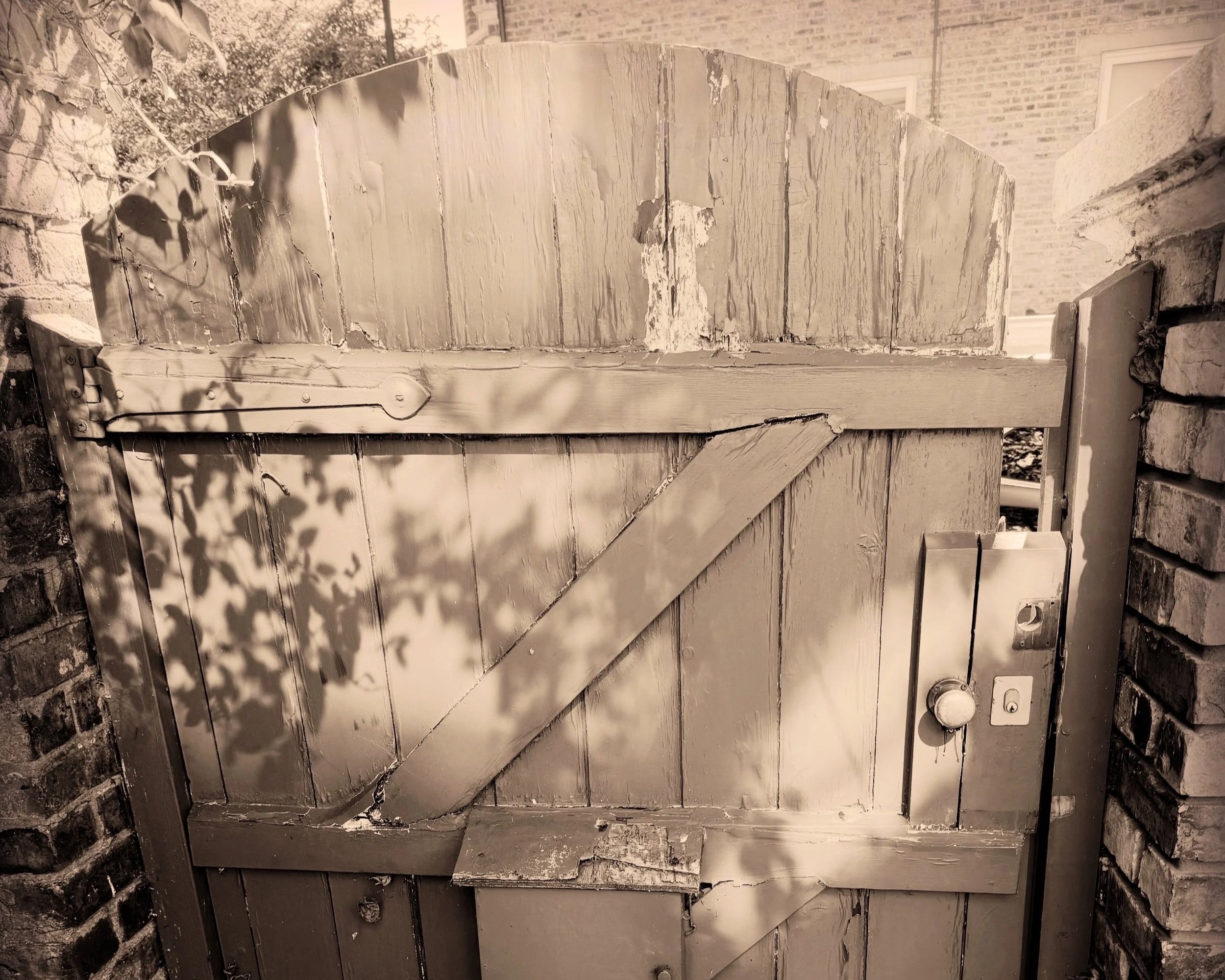
Green door? What’s that secret you’re keeping?
What actually happens at an initial Garden Design Consultation, and why it’s the first part of my design process.
I was in London recently to meet a new client and discover what was hiding behind this rather fabulous old garden gate.
It turned out to be a really interesting urban garden with plenty of potential. But before I draw a single line or start thinking about what the new garden might look like, I want to understand the people who live there. How do they use the garden now? What works and, probably more importantly, what doesn’t? What would make them spend more time outside? Do they want to entertain, garden, eat outside or simply have somewhere lovely to sit with a coffee?
These are some of the things we start talking about during an initial Garden Design Consultation. It’s essentially the beginning of the design process. Live, on the hoof.
First, I listen
Every consultation starts with a conversation.
I want to understand how you live and how you’d like to use the garden. Not how you think you should use it. There’s not much point designing an enormous entertaining space for someone who rarely has people over. Equally, a family who regularly has twelve people around for Sunday lunch probably needs rather more than a little table for two squeezed onto the patio.
We talk about what you like, what you don’t like and what you would change if you could. Sometimes clients already have very definite ideas. Sometimes the brief is essentially, “We know this garden doesn't work, but we have absolutely no idea what to do with it.”
Both are perfectly good places to start.
Then we look at the garden together
This is the bit I particularly enjoy.
We walk around the space and start looking properly. Where does the sun fall? Which parts of the garden are overlooked? Are there changes in level? What can we see beyond the boundaries? Is there an existing tree worth celebrating? Is there something particularly ugly we'd rather not look at?
I also look back towards the house. The relationship between house and garden is really important to me. I'll look at the architecture, where the doors are, the view from the kitchen or a bay window and how naturally you can move between inside and outside.
Then there’s all the really practical stuff. Access. Drainage. Storage. Steps. Existing materials. Neighbouring buildings. Where the barbecue might live. And, inevitably, where the bins will go.
None of it is particularly glamorous, but all of it matters.
Ideas start happening there and then
A Garden Design Consultation isn't a presentation where I arrive with a finished solution tucked under my arm.
I want to experience the garden first.
As we walk around, I'll start talking through ideas and possibilities. We might discuss moving a terrace, creating a stronger view from the house, changing levels, adding trees for privacy or completely reconsidering how you move through the garden.
Sometimes one observation unlocks the whole space.
Something that has always seemed like a problem might actually become an opportunity. An awkward level change could become an interesting part of the design. A neglected corner might be exactly where the evening sun falls. This is why I prefer having these conversations standing in the garden rather than trying to understand everything from photographs. You never quite know what you're going to find.
Why do I charge for a Garden Design Consultation?
Because it isn't a sales pitch.
A consultation is a professional service in its own right. You're paying for my time, experience, advice and ideas, and I want you to come away from the meeting with a much clearer understanding of your garden and what might be possible.
Sometimes that's all a client needs.
You might want an independent pair of eyes before making changes yourself. We can talk through what I'd keep, what I'd change, what I think the priorities should be and where your money might be best spent.
More often, the consultation becomes the beginning of a full garden design project.
And if we go on to work together on the design of your garden, I reimburse the consultation fee.
So you're not paying for a sales meeting before the design process starts. The consultation has already done some of the important thinking. I've met you, experienced the garden, started to understand the brief and we've begun exploring what the space could become.
What happens next?
If we're going on to work together, I'll use everything we've discussed during the consultation as the starting point for the design. That usually means properly surveying and analysing the site before I begin developing the design itself.
The conversations we had during that first meeting become an important part of the brief. Not just the practical requirements, but the smaller things too. Where you like to sit in the morning. The view you don't particularly like from the kitchen. The fact that you want somewhere for ten people to eat but don't want the whole garden dominated by a dining table.
Those details matter. Because ultimately I'm not just designing a garden. I'm designing a garden around the people who are going to live in it.
And sometimes all of that starts by opening a rather fabulous old gate and seeing what's on the other side.
Fancy a chat about your garden?
You can book an initial Garden Design Consultation with me at any time through my website. Just click Book Me, choose a time that works for you and tell me a little about your garden.
I work on residential gardens across Kent, London and the South East.
And remember, if your consultation goes on to become a full garden design project, I'll reimburse the consultation fee.