Legal edibles | The ancient brick wall that’s making me hungry
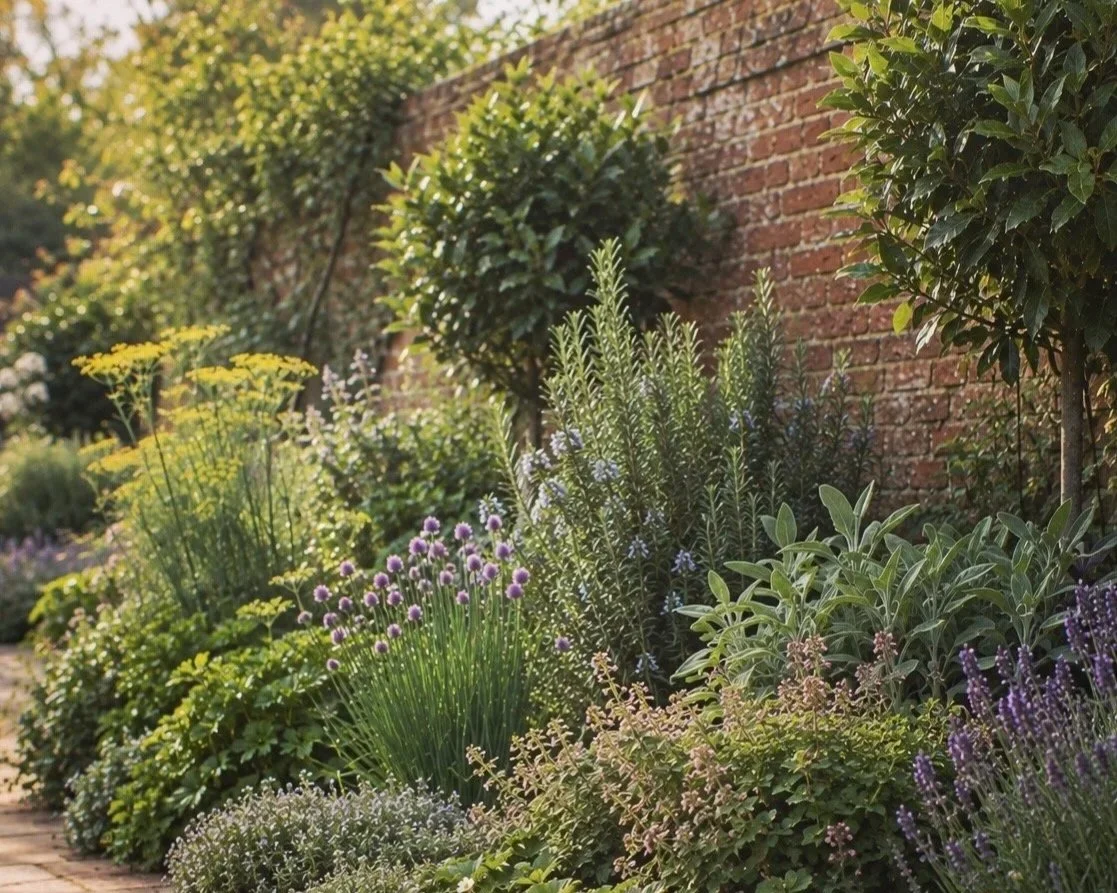
Planting design visual prepared for my client, using Photoshop.
There’s an original brick wall in the vicarage garden I’m designing in Deal, that is making me peckish.
It’s old, weathered and beautifully imperfect. And there’s something about it that immediately makes me think of the traditional kitchen gardens of period English houses. So rather than planting a purely ornamental border alongside this wall and the adjacent dining terrace, I want to create something beautifully edible instead.
Not a vegetable patch and not a typical herb garden. There won’t be any neat little rows with labels. It will look like a classic garden border, but be filled with herbs, fruit and flowering plants that happen to earn their keep in the kitchen too.
Taking a cue from the history of the house
One of the things I enjoy most about designing older gardens is looking for the clues that are already there. The original architectural style of the house, legacy trees, an undisturbed view or building materials that have been there for generations. They can all give you a starting point for a design. In this particular part of the garden, it is this lovely old wall.
Traditional kitchen gardens were hard-working places, but that didn’t stop them from also being beautiful. Fruit trees grew alongside herbs and vegetables, while flowers found their way in amongst the productive planting. Traditionally, there wasn’t necessarily the distinction we tend to make now between something being ornamental and something being useful. And I rather like that.
What am I planting?
The border isn’t uniformly sunny, which will make the planting scheme more interesting.
At the sunnier end of the border, I’ll use many of the Mediterranean herbs that are beautiful garden plants in their own right: Rosemary (Salvia rosmarinus), Creeping Rosemary (Salvia rosmarinus ‘Prostratus’), English Lavender (Lavandula angustifolia), common and purple Sage (Salvia officinalis), Thyme (Thymus vulgaris), Oregano (Origanum vulgare) and Chives (Allium schoenoprasum). Bronze Fennel (Foeniculum vulgare ‘Purpureum’) will bring some height and softness, while Nasturtiums (Tropaeolum majus) can scramble through the planting and provide edible flowers.
As the border becomes shadier, the palette changes.
Bay (Laurus nobilis), flat-leaf Parsley (Petroselinum crispum var. neapolitanum), Garlic chives (Allium tuberosum), Sorrel (Rumex acetosa), sweet Cicely (Myrrhis odorata) and Lemon Balm (Melissa officinalis) will all cope with less sun.
Towards the ground, Alpine Strawberries (Fragaria vesca) and sweet Violets (Viola odorata) can weave their way through the planting and soften the edges.
And there will, of course, be mint. But planted in a pot. I’m not that reckless!
Edible doesn’t have to look ‘productive’
It’s important to me that this should still feel like a designed border.
Two Bay trees will provide evergreen structure against the old wall, loosely shaped rather than clipped into perfect topiary. Beneath them, the planting will be relaxed and layered, with herbs, flowers and fruit mingling together rather than being separated according to what they do.
There’ll be the grey-green foliage of sage and lavender, dark evergreen rosemary, purple chive flowers, feathery bronze fennel and strawberries creeping around the edges.
In summer, brushing past the planting should release the smell of Rosemary, Thyme, Lavender and Mint into the air. So lovely for this to run alongside the dining terrace too. Imagine what that will smell like on a summer’s evening.
And when it’s time for a spot of cooking, my client can wander outside with a pair of scissors and come back with a bunch of home-grown ingredients.
What’s not to love?
Beautiful and useful
We sometimes treat productive gardens and ornamental gardens as though they are two completely different things, but I’m not sure they need to be. Some of our most useful edible plants are also very beautiful. Rosemary is an evergreen shrub, Sage has wonderful silver foliage and Chives produce masses of flowers. Fennel can hold its own in almost any perennial planting scheme.
Perhaps the old kitchen gardens had it right all along; Make it beautiful. Make it useful. And, whenever possible, make it delicious.