Designing with ornamental grasses | What you need to know
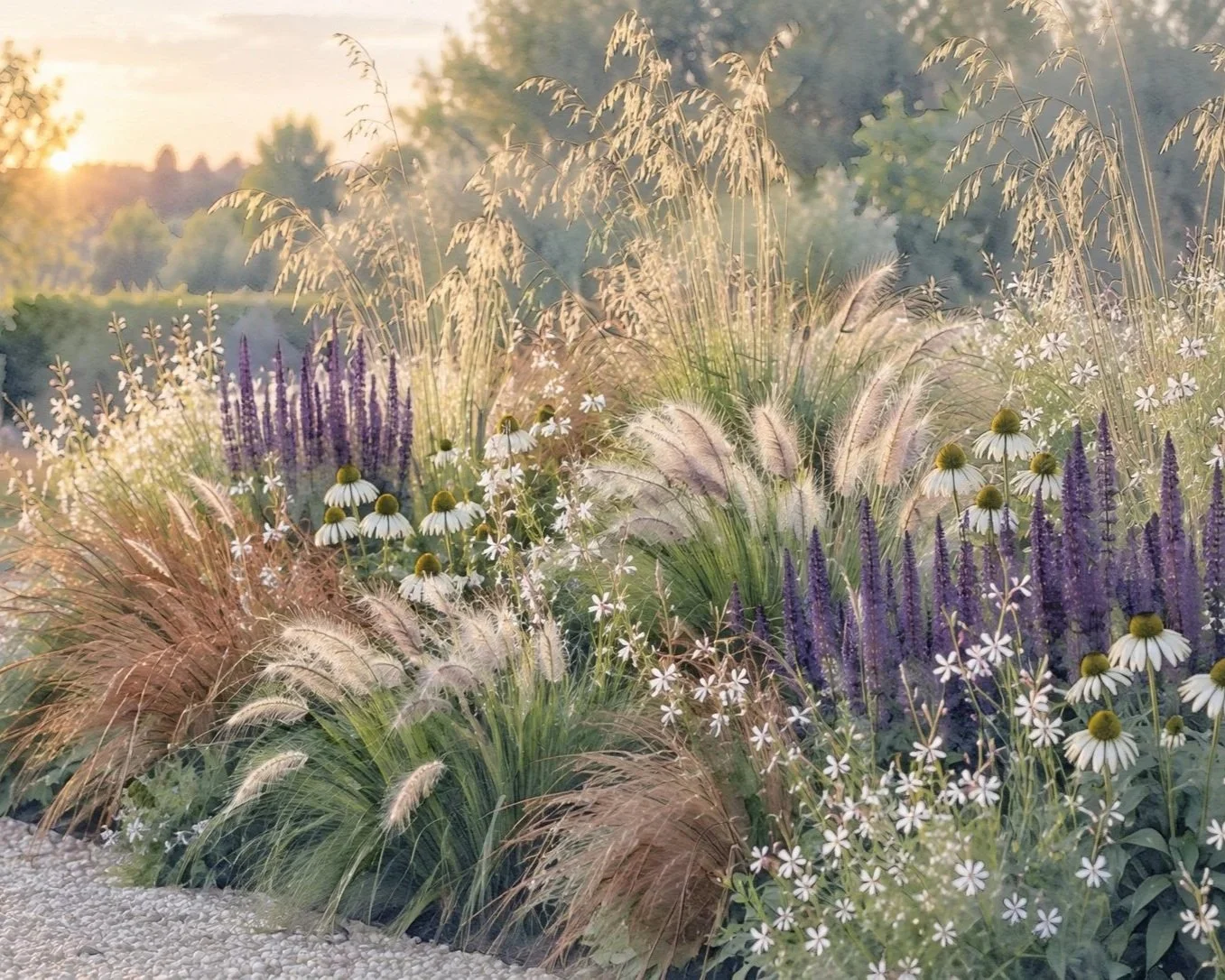
A planting border designed by Mark Hardy which features ornamental grasses and perennials
I posted the above image of a planting scheme I’d designed on Instagram this week, filled with ornamental grasses, and it got rather a lot of love. I completely understand why.
Grasses can change the mood of a garden. They move in the slightest breeze, catch the light and soften the harder edges of paving, walls and buildings. They’re also brilliant alongside more structured planting, stopping everything from feeling too formal or controlled. They’re something of a design superhero.
But creating that loose, hazy planting you see in a beautifully designed garden isn’t simply a matter of buying lots of grasses and dotting them through a border. That’s a fairly reliable way of ending up with a bit of a mishmash. The important thing is understanding what you want them to do.
Start with shape, not variety
It’s very easy to choose plants on their individual merits. You see something lovely at the nursery, read the label and pop it in the trolley, hoping for the best.
Designing a border works the other way around. I start with the effect I want to create, then find the plants that will achieve it.
With grasses, shape is particularly important. Some make low, arching mounds. Others are upright and architectural. Some send flower stems high above everything around them, while the finest are almost transparent.
Hakonechloa macra makes a lovely low mound and is brilliant for softening the edge of a path. Calamagrostis × acutiflora is much more vertical. Stipa gigantea sends its huge oat-like flower heads high above the planting without creating a great lump of foliage underneath.
They’re all ornamental grasses, but from a design point of view they do completely different jobs.
Those were my salad days
My planting design tutor at The Inchbald School of Design once told us, “A planting border isn’t a salad.”
That thoughts has stayed with me ever since.
One plant here, something different over there, another squeezed into a gap and suddenly you have a collection of nice plants rather than a well-designed planting scheme.
I prefer a restricted palette that repeats through the garden. With grasses this works particularly well because repetition creates rhythm and gives the planting a sense of continuity.
That doesn’t mean planting them at regular intervals. I might use a larger group in one area, bring a few towards the edge of a path and then pick up the same grass further along the border. They don’t even need to be planted in obvious groups. Let them drift through other plants and disappear in places.
The repetition is there, but we don’t need to shout about it.
A tall order
The old idea of short plants at the front, medium ones in the middle and tall ones neatly lined up at the back can make a border feel very flat. I’d much rather mix things up.
Tall, transparent grasses can come further forward because you can see through them. Put one close to a path or terrace and the planting starts to surround you rather than sitting obediently around the edge of the garden.
Lower grasses are useful in a different way. Their mounded shapes can push into paths, soften paving or create a repeated layer through a border.
It’s the change in height that creates depth. If everything finishes at roughly the same level, you lose much of the drama.
Dial up the contrast
I wouldn’t usually design a border using grasses alone. I like what happens when you put them next to plants that behave completely differently.
A loose grass beside a clipped yew dome immediately makes the yew feel more architectural and the grass even looser. Dark flower spikes such as Salvia nemorosa ‘Caradonna’ cut through softer foliage, while the tiny white flowers of Oenothera lindheimeri can almost disappear amongst it.
I also like plants to intermingle. Nothing in nature grows with a polite little gap around it, and borders can look strangely contrived when every plant is presented as an individual specimen.
Grasses are particularly good at knitting things together. Let foliage overlap, allow flowers to appear through them and don't worry if you can't see every plant in its entirety.
This is where grasses really earn their keep as the glue in a planting scheme.
I like to move it move it
Movement is probably what I love most about working with grasses.
Much of what we put into a garden is static. The paving, walls, furniture and clipped evergreens aren't going anywhere. Grasses react to whatever the weather is doing.
Even a light breeze is enough to move fine stems and seed heads. When it’s blowing a hoolie, the whole border can take on a different character.
That movement is worth designing for. I like grasses close enough to paths that they occasionally brush into the space, and where they can be seen from inside the house. It makes the garden feel alive even when nobody is in it.
Ray of light
If movement is one reason I love grasses, light is definitely the other.
The finest leaves and seed heads are brilliant at catching low sunlight, particularly when they’re backlit. A grass that looks unremarkable in the middle of the day can suddenly glow as the sun drops behind it.
I always consider this when positioning grasses. Where will the evening sun come from? Where are you likely to be sitting at that time of day? What will you see from the kitchen or through the doors from the house?
It can make the difference between simply finding a place where a grass will grow and putting it somewhere it becomes part of the experience of the garden.
And that effect carries well beyond summer.
Many deciduous grasses fade into straw, bronze and gold rather than simply dying back. Their dried stems and seed heads can look fantastic against dark evergreen planting or covered in frost. I leave them standing through winter for as long as they continue to look good.
Choosing the right grass
Only once I know what I want a grass to do, do I start narrowing down the variety.
Conditions obviously matter. There’s no point specifying a grass that wants full sun for a deeply shaded border, however perfect its shape might be.
For a lower, flowing grass in partial shade I might use Hakonechloa macra. Deschampsia cespitosa gives me something much taller and airier in conditions where some of the more sun-loving grasses might struggle.
In a sunny, open position, Stipa gigantea is one of my favourites for height and transparency. Pennisetum creates a much fuller mound with those fabulous bottlebrush flowers, so I might use it when I want more visual weight lower down.
So yes, soil, light, moisture and exposure matter enormously. But they're filters rather than the starting point. I work out what the planting needs first, then choose a grass that will give me that effect and thrive in the conditions I have.
Less salad, more garden
There are hundreds of ornamental grasses to choose from. You really don't need most of them. A handful of carefully chosen varieties, repeated confidently, will usually create a much stronger scheme than a border containing one of everything.
Look again at the image that prompted this article and there actually isn't anything particularly complicated going on. Tall grasses rise above lower mounds. White and purple perennials weave between them. Strong vertical shapes sit amongst much softer ones. Plants overlap and the whole thing moves.
That’s what I’m interested in.
Not the grass as an individual specimen, but what it contributes to everything around it.
Perhaps that’s why I use ornamental grasses so much. They can make a newly planted border feel less rigid, connect quite different plants and bring movement into a garden without filling it with more stuff.
And when the evening sun catches them, they’re difficult to beat.